
RETHINKING INDIA’S FERTILIZER POLICY: FROM PRICE MANAGEMENT TO AGRICULTURAL VALUE CHAINS
About the Event
How can India build a fertilizer policy that balances farmer affordability, efficient nutrient use, supply security and long-term agricultural sustainability?
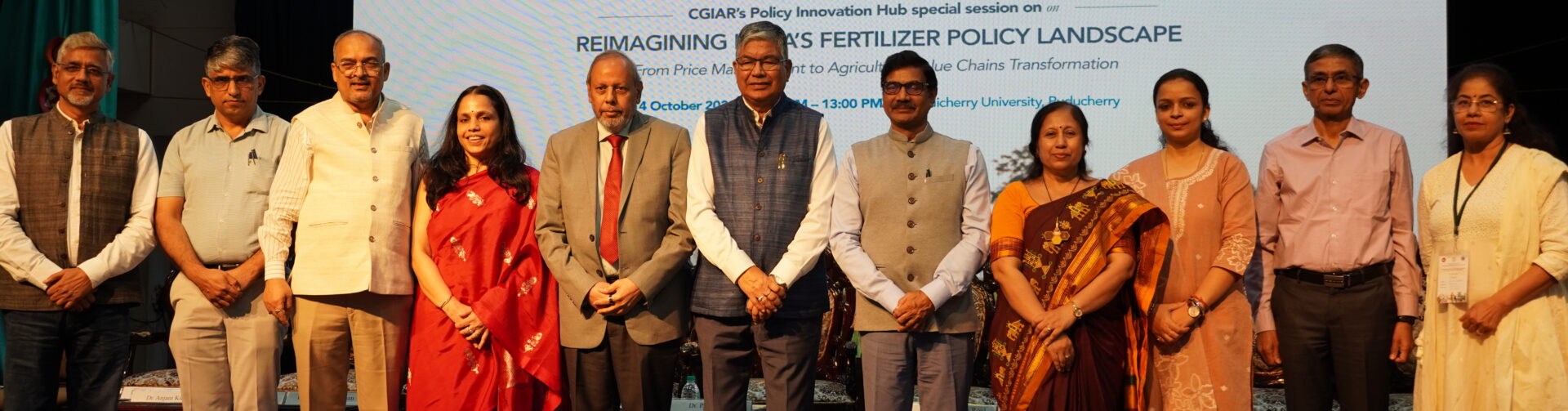
At the 34th Annual Conference of the Agricultural Economics Research Association (AERA), held at Pondicherry University on 14 October, the CGIAR Policy Innovation Hub convened a special session on “Reimagining India’s Fertilizer Policy Landscape: From Price Management to Agricultural Value Chains Transformation.”
The session was co-chaired by Prof. S. Mahendra Dev, Chairman, Economic Advisory Council to the Prime Minister (EAC-PM), and Dr. P.K. Joshi, President, AERA, India. The session opened with remarks by Dr. Anjani Kumar, IFPRI, followed by context-setting by Dr. Mamata Pradhan, IFPRI, who framed the discussion around the need to look beyond fertilizer prices and individual products towards a more efficient, resilient and nutrient-responsive agricultural system.
The panel brought together perspectives from government, research and the private sector:
- Dr. Chhabilendra Roul, Former Secretary, Department of Fertilizers, Government of India
- Dr. Prem Chand, Member, Commission for Agricultural Costs & Prices, Government of India
- Dr. Smita Sirohi, MS Swaminathan Chair ICAR-National Professor, ICAR-National Institute of Agricultural Economics and Policy Research
- Shri Amit Rastogi, Executive Vice President and Chief Technology Officer, Coromandel International Limited
- Smt. Priyanka Uday, Associate Director, Agriculture Research and Advisory, CRISIL Limited
- Prof. Seema Bathla, Centre for the Study of Regional Development, School of Social Sciences, Jawaharlal Nehru University
The discussion explored several interconnected dimensions of fertilizer policy:
- Subsidy design and policy alignment: How existing support mechanisms can be made more efficient while maintaining affordability for farmers and considering the fiscal implications of global supply and price shocks.
- Balanced nutrient management: The need to address nutrient-use imbalances through better soil-health information, crop-specific recommendations, greater awareness and appropriate incentives for farmers.
- Evidence for sustainable nutrient use: The importance of understanding how nutrient management affects productivity, farm economics and emissions across different crops and regions, rather than assuming that one approach will work everywhere.
- Fertilizer security and domestic capacity: Options for reducing exposure to external supply disruptions, strengthening domestic production and exploring alternative nutrient sources.
- Industry and agricultural value chains: The potential for the fertilizer industry to move beyond supplying individual products towards integrated plant nutrition, agronomic advisory and other services that respond to farmers’ needs.
- Targeted support and inclusion: The practical considerations involved in subsidy rationalization and direct benefit transfers, including differences across states, the needs of small and marginal farmers, and the importance of reliable land and farmer records.
A central thread running through the discussion was the need to consider fertilizer policy as part of a wider agricultural system. Price signals, subsidy design, crop choices, soil health, farmer profitability, research and extension, and market incentives are closely connected. The session highlighted the value of bringing policy, academic and industry perspectives together to examine these trade-offs and identify pathways towards more efficient, resilient and sustainable nutrient management.