
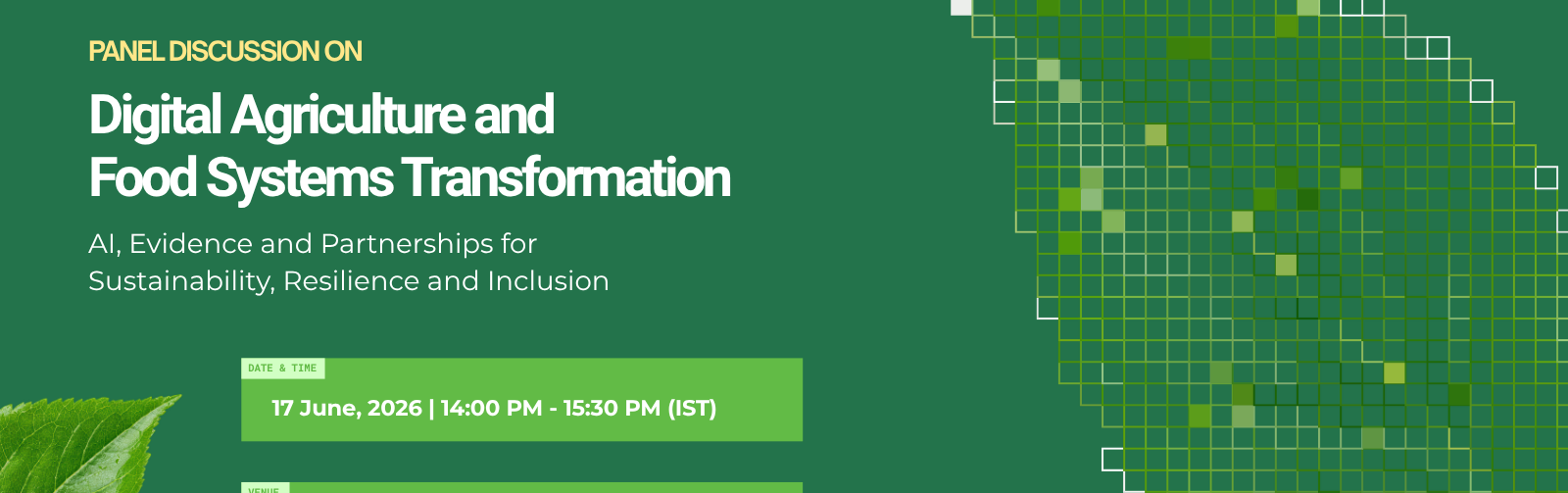
DIGITAL AGRICULTURE AND FOOD SYSTEMS TRANSFORMATION: AI, EVIDENCE AND PARTNERSHIPS FOR SUSTAINABILITY, RESILIENCE AND INCLUSION
Jointly organized by the International Food Policy Research Institute (IFPRI), the International Crops Research Institute for the Semi-Arid Tropics (ICRISAT), and the CGIAR Science Program on Policy Innovations at the AERA Regional Seminar.
ABOUT THE EVENT
As India advances its Digital Agriculture Mission and strengthens its Digital Public Infrastructure for agriculture, there is a growing need to examine how digital innovations, artificial intelligence, data systems, and evidence-based policymaking can contribute to more productive, climate-resilient, and inclusive agri-food systems.
Given this context, The International Food Policy Research Institute (IFPRI), the International Crops Research Institute for the Semi-Arid Tropics (ICRISAT), and the CGIAR Science Program on Policy Innovations are jointly organizing a Panel Discussion titled “Digital Agriculture and Food Systems Transformation: AI, Evidence and Partnerships for Sustainability, Resilience and Inclusion” at the Agricultural Economics Research Association (AERA) Regional Seminar.
The session will bring together policymakers, development partners and private-sector experts to discuss pathways for translating digital innovations into scalable solutions that benefit farmers, extension systems, and value chain actors.
The session will also feature a panel discussion titled, “From Pilots to Scale: What Will Make Digital Agriculture Actionable, Inclusive, and Accountable?”, which will explore key issues including digital public infrastructure, AI-enabled advisory systems, climate-smart agriculture, evidence and impact assessment, responsible data governance, and institutional mechanisms for scaling digital agriculture.
Objectives:
- Assess the current state of India’s digital agriculture transition and its implications for food systems transformation, farmer incomes, and climate resilience.
- Highlight innovative and AI-enabled approaches such as digital public infrastructure, remote sensing, crop and climate analytics, advisory decision-support systems, and generative AI-enabled service delivery.
- Discuss how research evidence, economic analysis, field-tested innovations, and private-sector capabilities can be combined to move digital agriculture from pilots to scalable institutional models.
- Examine safeguards for inclusion, particularly for smallholders, women farmers, lagging regions, and digitally excluded communities.
- Identify priority areas for collaborations on digital agriculture, climate-smart advisory systems, impact evidence, policy support, and responsible data governance.