THE MAKING OF A SURVEY: DESIGNING A GENDER DISAGGREGATED FARMER SURVEY IN ODISHA
Every year on 15th October, the United Nations observes the International Day of Rural Women, recognizing the many roles women play in agriculture, food security, and poverty reduction. In Odisha, these contributions are reflected in the everyday decisions women make on farms, the labor they contribute, their engagement in the agri-value chain, and the livelihoods they help sustain.
Yet an important question remains: do policies and programs adequately recognize and support women farmers? In Odisha, public support reaches women through multiple channels. Some receive assistance under the state’s flagship Subhadra scheme , while others benefit from an old age pension scheme. At the same time, questions remain about how effectively social protection, agricultural support, and collective participation can strengthen women's livelihoods in a state that has made significant progress in placing women at the center of its development agenda.
Odisha’s commitment is reflected in its public spending. According to the state’s Budget Estimates 2026-27, about 40% of the total budget has been allocated to Gender Responsive Budgeting (GRB). The share of GRB in the state's budget has increased steadily in recent years.
To assess the gender responsiveness of the government policies and programs, the International Food Policy Research Institute (IFPRI) partnered with the Department of Agriculture and Farmers’ Empowerment (DA&FE), Government of Odisha to establish the Gender Responsive Cell (GRC). The GRC aims to embed gender equity into agricultural policy, services, and outcomes for women farmers.
Structural transformation creates new opportunities, but these opportunities are not always distributed equally. Ensuring that gender equity is incorporated into policy design and implementation is therefore essential. As part of this work, the IFPRI team developed a framework to classify these polices into three categories:
Gender Neutral Policies
These interventions provide uniform subsidies and support to both men and women, operating under the assumption that access has been historically equal. For example, schemes providing subsidized seeds to farmers often require the applicants to be registered for farmers who own land. This structural requirement ineluctably excludes women cultivators, tenant farmers, and widows. As a result, policies that appear gender neutral on paper are not neutral in practice because they interact with existing social norms and institutional barriers.
Gender Sensitive Policies
These initiatives provide enhanced benefits to women or expand outreach through Women Self-Help Groups (WSHGs). While they actively include women, they may not fully address the structural barriers that limit women's access to resources and opportunities. In agri-food systems, such policies often still fail to recognize women as independent cultivators.
Gender Specific Policies
These initiatives are designed specifically to address gender disparities and target women beneficiaries directly. Our analysis revealed that most agricultural schemes in Odisha are gender sensitive in nature, while truly gender specific schemes remain limited, although notable examples exist, such as Odisha’s Mushroom & Floriculture Mission.
Using this framework, we identify four major barriers to equitable access:
- Land Ownership and Record of Rights (RoR) requirements, which disproportionately disadvantage women.
- High upfront capital requirement and documentation burden, which limit participation.
- Information and Gaps: Limited digital literacy gaps, including challenges navigating online portals and application systems.
- Mobility constraints arising from traditional gender roles.
To complement these qualitative findings, we conducted a comprehensive evaluation of Odisha’s gender budgets over the past six years. This allowed us to identify schemes that have consistently received high fiscal allocation while maintaining robust utilization rates, measured as the ratio of Actual Expenditure (AE) and Budget Expenditure (BE).
Together, the landscape analysis and GB analysis gave us a fair understanding of how agricultural schemes are designed and funded. However, they could not tell us how these programs are experienced in practice by the men and women.
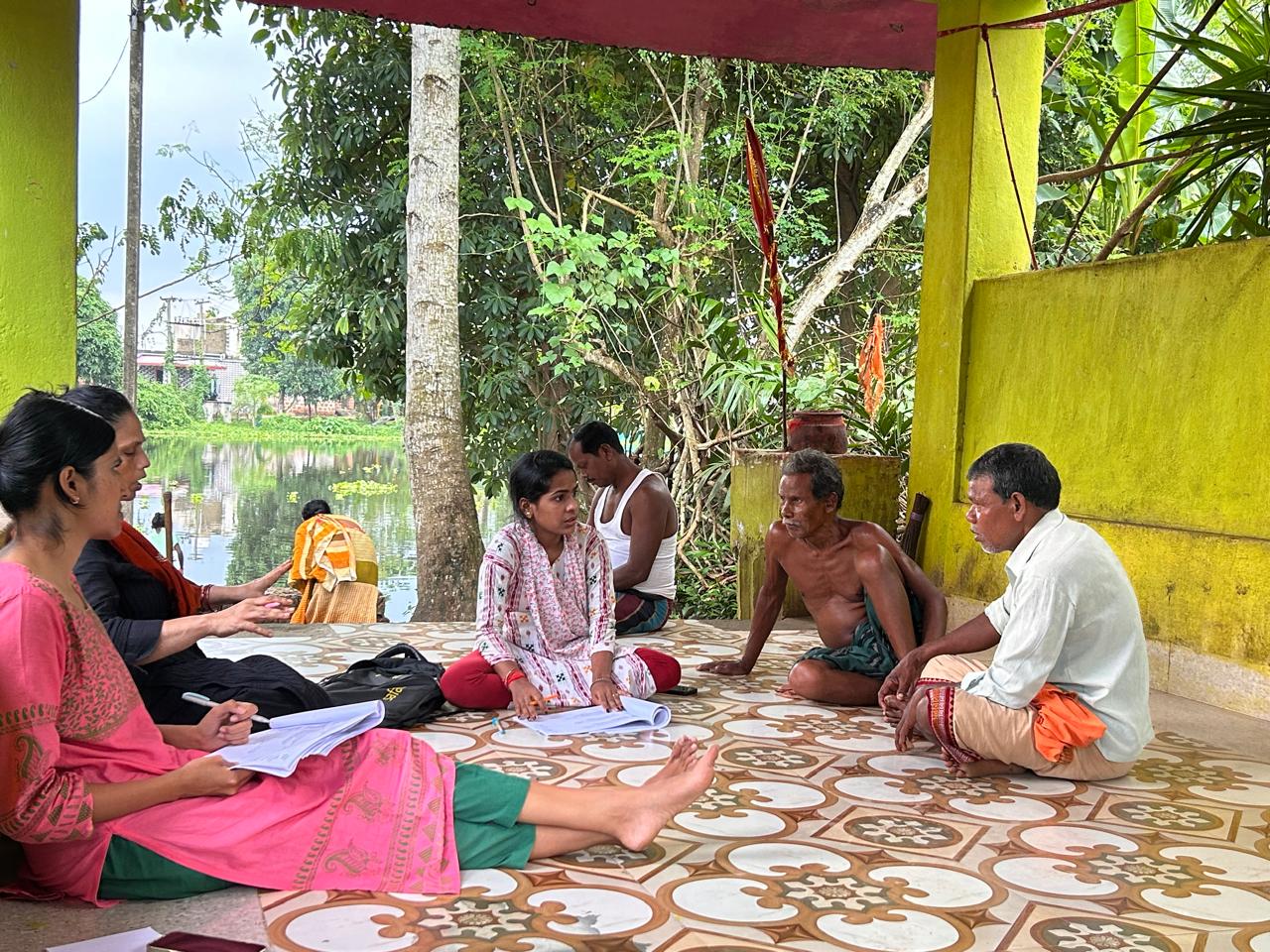
To address this gap, we designed and implemented a survey with a representative sample, where districts were selected based on a composite index to gauge the uptake and reach of agricultural schemes. The survey instrument was designed to collect gender-disaggregated data across three dimensions: awareness, utilization, and impact of schemes in the agriculture and allied sectors focusing on three core questions:
- Gender-Based Variations in Awareness: How does knowledge of policies and programs in the agriculture and allied sectors differ between women and men?
- Intra-Household Variation in Participation: How does access to benefits and participation differ within the household?
- Differential barriers to access: What distinct obstacles do individual household members face when attempting to access schemes and programs?
Learning from global approaches to gender-disaggregated data collection
The survey drew on established global frameworks for collecting gender-disaggregated data and was adapted to Odisha's context. We adopted principles from the World Bank's LSMS+ and the Women's Empowerment in Agriculture Index (WEAI), including collecting information directly from individuals and conducting paired interviews with male and female decision-makers within households. We also drew on the FAO's macro-meso-micro framework to understand how policies are implemented through institutions and experienced by individuals. This helped us design survey modules that captured both household experiences and interactions with the systems delivering agricultural schemes and services.
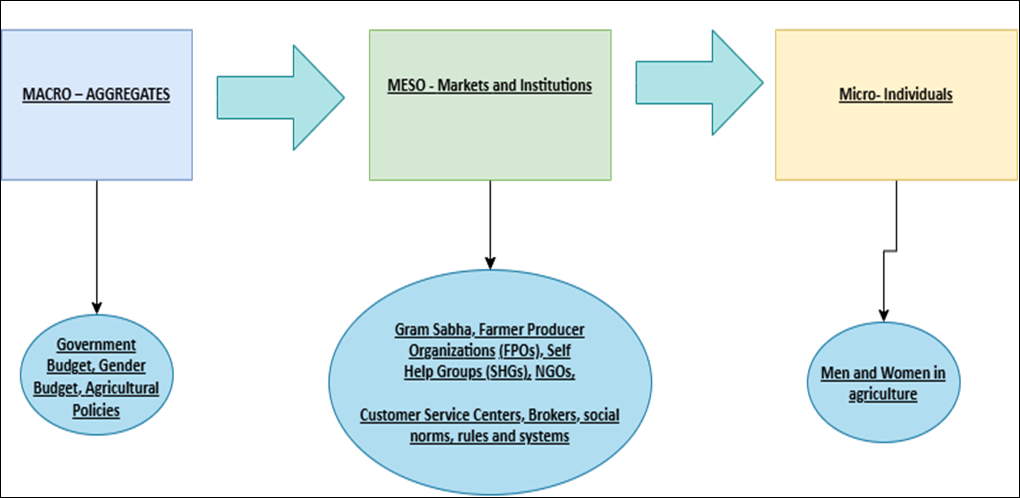
Figure 1: Gender in the macro-meso-micro framework (adapted from Elson, Evers and Gideon, 1997)
Conclusion
Polices aimed at expanding opportunities in the agricultural sector must be supported by accurate data that reflects the economic realities of both men and women, individually and within households. Intra-household analysis enables policymakers to go beyond asking whether a policy reached a household to understanding who within the household benefited and where barriers to access persist.
Such evidence can help refine eligibility criteria, make outreach channels more inclusive, and simplify dissemination processes. Our experience also shows that while global provide valuable guidance, they must be adapted to local contexts. By tailoring survey tools to Odisha’s realities, we were better able to capture the interactions between farmers and the institutions delivering agricultural schemes and services.
Ultimately, producing evidence to improve policy requires tools rooted in local circumstances. This approach helps ensure that gender equity is not just an aspiration but a measurable metric embedded within the state's agricultural framework. By translating global standards into locally relevant evidence, these insights provide an actionable blueprint for designing more inclusive, effective, and impactful agrarian reforms in Odisha.
References
Government of Odisha, Finance Department. (2026). Gender Budget 2026–27. Government of Odisha.
Government of Odisha, Finance Department. (2025). Gender Budget 2025–26. Government of Odisha.
Elson, D., Evers, B. and Gideon, J. (1997). Gender-aware Country Economic Reports: Concepts and Sources, Working Paper No. 1, Genecon Unit, Graduate School of Social Sciences, University of Manchester, mimeo
Hasanbasri, Ardina; Kilic, Talip; Koolwal, Gayatri; Moylan, Heather. 2021. LSMS+ Program Overview and Recommendations for Improving Individual‑Disaggregated Data on Asset Ownership and Labor outcomes. Washington, D.C.: World Bank Group.
Seymour, G., Ferguson, N., van Biljon, C., & Malapit, H. (2023). User guide on the project-level women’s empowerment in agriculture index (Pro-WEAI). Washington, DC: IFPRI.
Acknowledgements
We sincerely thank the senior officials of the Department of Agriculture and Farmers’ Empowerment (DA&FE), Government of Odisha, particularly Sri Sachin Ramchandra Jhadav (IAS), Commissioner-cum-Secretary to the Government; Sri Shubhranshu Mishra (OAS), Additional Secretary to the Government; Dr. Sangram Keshari Pattanaik (retd.), former Joint Director of Agriculture; and Sri Nagendra Kumar Mallik, Deputy Director of Agriculture, for their guidance and support in the development of the survey instrument. We also extend our sincere thanks to our colleagues Vandana Vidhani, Research Analyst at IFPRI, and Amit Burman, Project Coordinator at IFPRI, for their valuable support and contributions.
Bhumika Mishra is a Research Analyst at IFPRI; Archismita Bose is a Research Analyst at IFPRI; Dr. Mamata Pradhan is a Senior Research Coordinator at IFPRI; Dr. Devesh Roy is a Senior Research Fellow at IFPRI. Opinions are of the authors.
Banner Image Credit: Bhumika Mishra, Research Analyst, IFPRI