
IFPRI, ICRISAT AND ICAR CONVENE HIGH-LEVEL DIALOGUE ON FOOD SYSTEMS TRANSFORMATION FOR VIKSIT BHARAT AND LAUNCH INDIA POLICY INNOVATION HUB
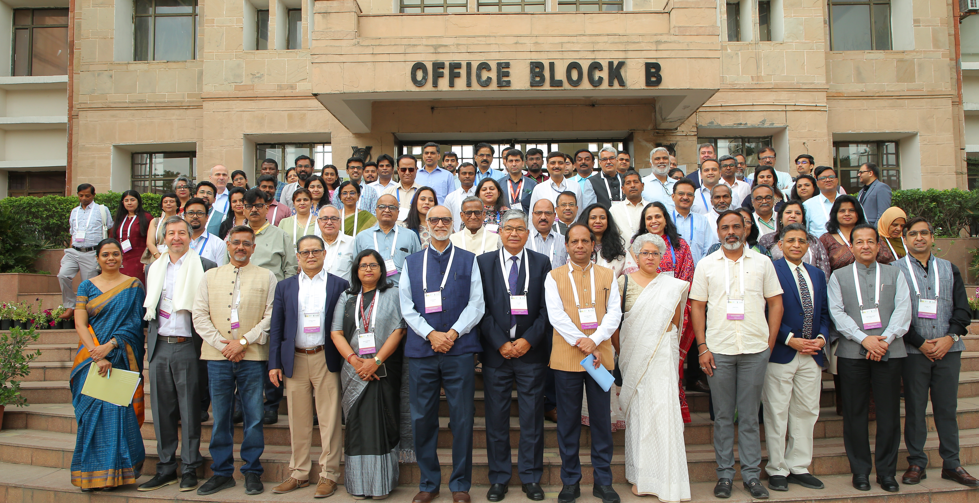
New Delhi | 8 April 2026: Senior policymakers, economists, scientists and development partners came together today at the NASC Complex in New Delhi for a high-level dialogue on “Evidence-Led Food Systems Transformation Policies in the Context of Viksit Bharat.” The event was jointly organized by the International Food Policy Research Institute (IFPRI) and the International Crops Research Institute for the Semi-Arid Tropics (ICRISAT), in collaboration with the Indian Council of Agricultural Research (ICAR), under the CGIAR Science Program on Policy Innovations. The dialogue focused on how evidence, data and partnerships can help India build more resilient, productive and nutrition-sensitive food systems in line with the vision of Viksit Bharat.
Opening the event, Dr. Shahidur Rashid, Director – South Asia, International Food Policy Research Institute (IFPRI) underscored the need to connect technological advances with policy change. “Policy influences technological innovation through regulation and incentives, and technological innovation in turn shapes productivity and growth. The challenge is marrying the two. The India Policy Innovation Hub provides a platform to bring together insights from across CGIAR centers and our national partners to support India’s larger development vision” he said.
Setting the context, Dr. Clemens Breisinger, Director, CGIAR Policy Innovations Science Program, described the India Policy Innovation Hub as a forward-looking step toward institutionalizing continuous engagement between researchers and policymakers. Dr Breisinger remarked, “the launch of the India Policy Innovation Hub represents a forward-looking step toward institutionalizing continuous engagement, accelerating the flow of insights from research to policy, and supporting coordinated action for resilient and inclusive food systems.” He emphasized that the Hub would serve as a collaborative platform for national and international research institutions, policymakers and development partners to work together more effectively, drawing on CGIAR’s tools, data systems and analytical frameworks to make evidence more accessible and actionable.
Drawing on long-term village studies in Uttar Pradesh, Dr. Madhura Swaminathan, Professor and Head, Economic Analysis Unit, Indian Statistical Institute-Bangalore, highlighted how technological change alone cannot ensure equitable development. Dr Swaminathan shared that “technology gains are not automatically shared fairly. Structural inequalities remain, and these cannot be addressed through technology alone. We need policy changes that ensure the benefits of innovation reach all farmers.”
Dr. Himanshu Pathak, Director General, International Crops Research Institute for the Semi-Arid Tropics (ICRISAT), emphasized that sound policy is central to development, particularly at a time when India faces increasing climate, financial and geopolitical risks. “The Hub can help us map and share evidence, identify key drivers of policy innovation, and strengthen capacities at both state and national levels”, he said
Delivering the Guest of Honor address, Dr. Arabinda Kumar Padhee, IAS, Additional Chief Secretary to the Government, Revenue and Disaster Management Department, Government of Odisha, stressed that meaningful transformation requires the alignment of policy, society and the environment. “Platforms like the India Policy Innovation Hub can help transform field-level learning into global policy insights. Policy must be well-designed, adaptive and outcome-oriented, and grounded in the realities of farmers and communities,” Dr. Padhee added.
In his Chief Guest address, Prof. Ramesh Chand, Member, NITI Aayog, called for a shift from a narrow focus on production toward a broader food systems perspective that considers sustainability, equity and long-term impacts. He said: “We need to move toward food systems thinking. We must consider the impacts on groundwater, emissions, nutrition and future generations. The India Policy Innovation Hub is the need of the hour to ensure that evidence, rather than populism, guides policymaking.”
The first technical session focused on the major drivers shaping India’s food systems, including price policies, climate change and trade. Dr. Ashok Gulati, Distinguished Professor, Indian Council for Research on International Economic Relations (ICRIER), highlighted the need to revisit current food, fertilizer and power subsidies to support crop diversification and more climate-resilient agriculture. He added that India’s future food system must be more diversified, demand-driven and climate resilient, while also ensuring nutritional security and better returns for farmers. Senior officials from Odisha and Bihar also discussed state-level roadmaps and priorities, highlighting the importance of aligning national goals with state-specific pathways and local realities.
The second session examined commodity-specific evidence and policy options for crop diversification and sustainable production systems, with presentations on millets and pulses, rice, and maize and wheat. A panel discussion brought together experts from CGIAR centers and Indian institutions to discuss how evidence from livestock, fisheries, forestry, water and natural resource management can better inform policy and investment decisions. Participants emphasized the need for stronger incentives for diversification, climate adaptation and nutrition-sensitive agriculture.
Chairing the session, Dr. P.K. Joshi, President, Agricultural Economics Research Association (AERA), India, stressed that scaling up successful innovations requires stronger extension systems, greater engagement with the private sector, and better alignment across institutions and policies. He also emphasized the need for the India Policy Innovation Hub to document what works, identify policy bottlenecks and build capacities across researchers, practitioners and policymakers.
A key highlight of the day was the launch of the India Policy Innovation Hub – a co-creation platform designed to strengthen engagement between researchers, policymakers and development partners at both national and state levels. The Hub aims to accelerate the translation of data, analytics and field evidence into timely, practical and context-specific policy solutions. Participants emphasized that the platform could help India respond more effectively to climate risks, market volatility, dietary transitions and the growing need for resilient and inclusive food systems.
The dialogue concluded with reflections on the way forward, with participants emphasizing that achieving the goals of Viksit Bharat will require stronger partnerships, sustained evidence generation and more effective mechanisms to connect research with policymaking. The India Policy Innovation Hub was envisioned as a long-term platform to support more coordinated, evidence-led policy decisions for India’s agri-food systems.