IFPRI AND RIS RENEW PARTNERSHIP TO STRENGTHEN REGIONAL COOPERATION AND POLICY RESEARCH ACROSS SOUTH AND SOUTHEAST ASIA
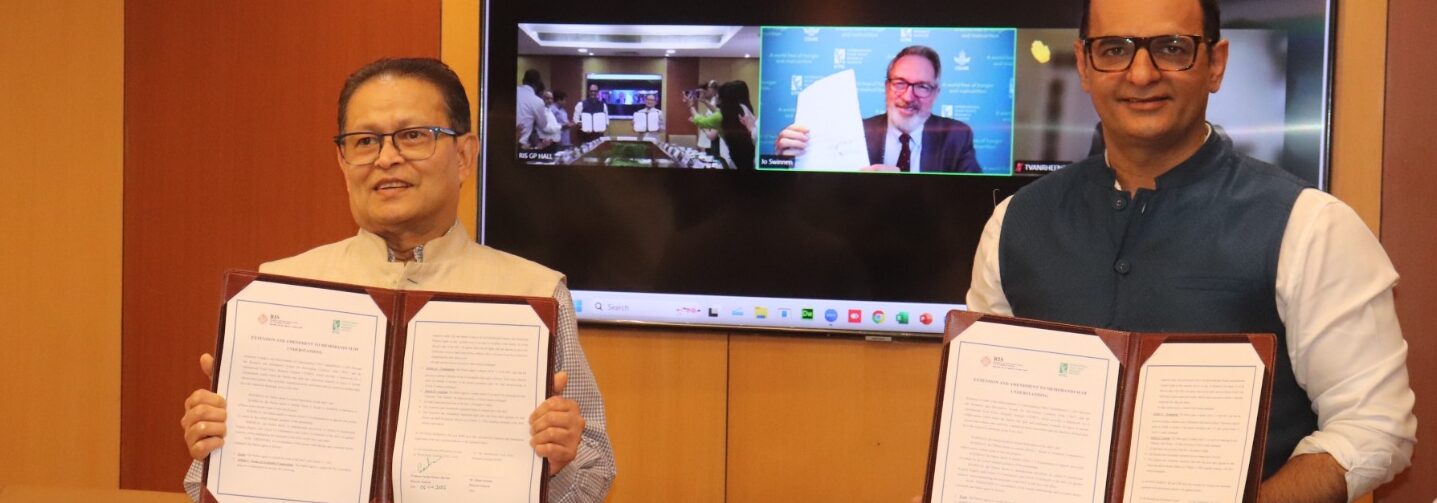
The International Food Policy Research Institute (IFPRI) and the Research and Information System for Developing Countries (RIS) renewed their partnership through the signing of an extension agreement to their Memorandum of Understanding (MoU), reaffirming their shared commitment to advancing evidence-based policy research, regional cooperation, and institutional capacity building across South and Southeast Asia. The renewed agreement, signed on 7 April at the RIS office, extends the IFPRI-RIS partnership through March 2031 and broadens the scope of collaboration to respond to emerging regional priorities and challenges.
Originally signed in 2021, the partnership was established to strengthen cooperation between IFPRI and RIS in promoting research, policy dialogue, and knowledge exchange on issues of regional importance. The renewed MoU builds on progress made over the past five years and reflects the growing importance of regional cooperation in the context of climate change, food system transformation, geopolitical uncertainty, and the increasing emphasis on South-South and triangular cooperation.
Under the renewed agreement, IFPRI and RIS will collaborate on research and policy engagement in a range of areas, including agriculture, international trade, investment and connectivity among BIMSTEC member states and the wider Indo-Pacific region, including Pacific Island Countries. The partnership will also support work on the blue economy, disaster and pandemic management, sustainability, SDG tracking, technology transfer, artificial intelligence, and institution building. The two institutions will jointly undertake research projects, organize conferences and seminars, support capacity-building programs, facilitate exchanges of researchers, and produce joint publications and other knowledge products.
The renewed partnership is expected to reinforce ongoing collaboration with regional platforms such as the Association of Southeast Asian Nations (ASEAN) and the Bay of Bengal Initiative for Multi-Sectoral Technical and Economic Cooperation (BIMSTEC). Through these engagements, IFPRI and RIS aim to support more inclusive, sustainable, and climate-resilient agri-food policies, while strengthening data systems and policy coordination across the region.
The partnership will also contribute to strengthening the institutional capacity of DAKSHIN, the Centre of Excellence for the Global South launched by the Government of India following India’s G20 Presidency.
“Today marks the renewal of the MoU that our two institutions originally signed in March 2021,” said Johan Swinnen, Director General of IFPRI. “The Government of India’s increasing emphasis on South-South and triangular cooperation, particularly following India’s G20 Presidency, has further enhanced the strategic importance of this partnership.” Swinnen added that DAKSHIN, together with the growing need for regional policy coordination, presents “a unique opportunity to transform the RIS–IFPRI partnership into a credible platform for evidence-based policy dialogue.”
RIS Director General Sachin Kumar Sharma emphasized the importance of stronger collaboration among think tanks and across countries to address global challenges and advance food systems transformation. “We need greater collaboration between think tanks and countries to respond to global challenges and advance food systems transformation,” Sharma said. “Agriculture is central to amplifying the voice of the Global South, and DAKSHIN has an important role to play. This MoU will help us share best practices across the Global South and build on the important work that RIS and IFPRI have undertaken together over the past five years.”
Sharma noted that the partnership has already contributed to research, capacity building, and policy dialogue, and said the renewed agreement would place particular emphasis on training young researchers in India and generating practical knowledge products. He also expressed his appreciation for IFPRI’s high-quality research and said he looked forward to expanding the partnership across multiple platforms, including future collaboration in Africa. “I will extend my full support to operationalize and expand this MoU by leveraging our respective strengths, learning from each other and furthering it across various platforms,” Sharma said. “Our work together must produce outputs that are relevant to policy and practice, not only academic exercises.”
Dr. Shahidur Rashid, Director of IFPRI’s South Asia Office, said the partnership was originally designed to build on the complementarities and synergies between the two institutions. “IFPRI and RIS each bring distinct strengths, and this MoU allows us to take advantage of the synergies and complementarities across those,” Rashid said. “Our collaboration with ASEAN and BIMSTEC has already created momentum, including joint work on trade, regional connectivity, and policy analysis.” Rashid noted that one of the key areas identified for future collaboration is the development and analysis of granular trade and policy data across BIMSTEC and ASEAN countries. He also highlighted plans for the second phase of the Network of Policy Advisors and Analysts (NePAA) as a community of practice that will support shared learning and policy engagement across the two regions.
The agreement designates Dr. Shahidur Rashid, Director of IFPRI’s South Asia Office, and Dr. Sachin Kumar Sharma, Director General of RIS, as the focal points for guiding the partnership. By combining IFPRI’s expertise in food policy research with RIS’s strong regional networks and policy engagement, the renewed partnership is expected to generate new knowledge, strengthen institutions, and support more effective policy responses to the complex challenges facing the region.