STATE LEVEL CONSULTATION ON ROLE OF NATURAL RESOURCE MANAGEMENT PRACTICES TOWARDS ADDRESSING CLIMATE CHANGE, GENDER EQUALITY AND NUTRITIONAL SECURITY
Organized by WASSAN in collaboration with Gender, Climate Change and Nutrition Integration Initiative (GCAN) led by IFPRI
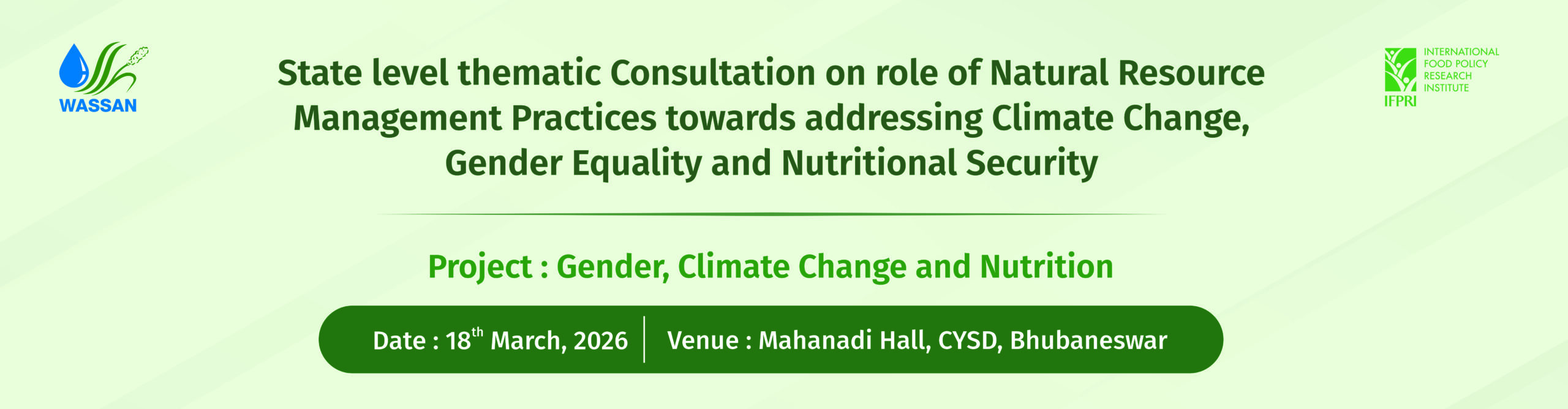
Event: State level consultation on role of natural resource management practices towards addressing climate change, gender equality and nutritional security
Date: 18 March 2026 | Time: 10:00 am to 4:00 pm IST
Location: Centre for Youth and Social Development (CYSD), Bhubaneswar, Odisha
About the event
WASSAN, under the Gender, Climate Change and Nutrition Integration Initiative (GCAN) led by IFPRI, is organizing four State-Level Thematic Consultation to facilitate evidence-informed policy dialogue. These consultations build upon Participatory Rural Appraisal (PRA) exercises conducted across four physiographic zones, which documented region-specific vulnerabilities, gendered constraints, livelihood transitions, and nutrition-related challenges.
The second consultation, on role of natural resource management practices towards addressing climate change, gender equality and nutritional security, will synthesize PRA findings to build a common understanding of gender-differentiated access to land, water, and forest resources across agro-climatic zones and their implications for household nutritional security. The session will then review relevant central and state policies related to watershed management, forest rights, irrigation, and decentralized governance to identify gaps in access, participation, and benefit-sharing across genders. Finally, participants will deliberate on feasible governance reforms and convergence mechanisms to improve equitable access to natural resources and mitigate climate-induced ecological stress.
Background and Structural Context
Agriculture continues to be the backbone of India’s rural economy, employing approximately 46 percent of the national workforce, with Odisha reflecting even higher engagement at nearly 49 percent (Economic Survey of India 2023–24; PLFS 2023–24). Recent labour force data show a reversal in structural transformation trends, with an increasing proportion of workers returning to agriculture between 2019–20 and 2023–24. In Odisha, the agricultural workforce expanded from 83.5 lakh to 104 lakh during this period, marking a 25 percent increase. Notably, women’s participation increased approx 72%, signaling accelerated feminization of agriculture (PLFS 2023–24; Odisha Economic Survey 2024–25). While rising participation reflects women’s expanding engagement in productive activities, empirical research demonstrates that drudgery, labour feminization does not necessarily translate into enhanced control over land, assets, income, or decision-making authority (Agarwal 2018; FAO 2011). National data show that women own a disproportionately small share of operational landholdings, limiting access to institutional credit, crop insurance, extension services, and formal markets (NSSO 2019). This structural imbalance reinforces gendered vulnerability within agrarian systems.
Climate Variability and Regional Differentiation
Odisha’s four Physiographic zones Northern Plateau, Eastern Coastal Plains, Western Dryland, and Southern Highland experience differentiated climate risks. Coastal regions face cyclonic events and salinity intrusion, dryland belts confront recurrent drought and declining soil moisture, and highland forested areas experience land degradation and ecological stress. The Intergovernmental Panel on Climate Change (IPCC 2022) highlights that climate variability disproportionately affects populations with limited adaptive capacity, particularly women engaged in natural resource-dependent livelihoods. Empirical evidence indicates that climate shocks increase unpaid care burdens, reduce dietary diversity, and intensify livelihood precarity among women-headed or migration-affected households (FAO 2018; World Bank 2021). In Odisha, climate-induced crop losses and male migration have contributed to women assuming greater managerial responsibilities in agriculture without commensurate institutional recognition.
Gendered Pathways to Nutrition Security
Nutrition security is shaped not only by food production but by intra-household allocation, income control, crop diversity, and access to public services. Research demonstrates that women’s control over agricultural income significantly improves dietary diversity and child nutrition outcomes (Quisumbing et al. 2014; Ruel and Alderman 2013). Diversification toward pulses, millets, horticulture, and indigenous crops enhances micronutrient availability while strengthening climate resilience (Pingali 2015; DeFries et al. 2017). Despite improvements in key indicators, Odisha continues to face district-level disparities in malnutrition, particularly among tribal and climate-vulnerable populations (NFHS-5 2019–21). Climate stress, livelihood instability, and gender norms intersect to affect nutritional outcomes, underscoring the need for integrated policy responses.
Policy Commitments and Scope
The Government of Odisha has demonstrated substantial commitment to gender-responsive and nutrition-sensitive development. The state has implemented numerous women-focused and gender-budgeted schemes, and gender-specific agricultural expenditure has increased significantly in recent years (Department of Finance, Government of Odisha, 2021). For instance, initiatives under POSHAN Abhiyaan and the Integrated Child Development Services (ICDS) provide supplementary nutrition to pregnant women, lactating mothers, adolescent girls, and children through Anganwadi centres, while promoting nutrition gardens and dietary diversification. In the agricultural domain, Odisha Millets Mission (Shree Anna Abhiyaan) promotes climate-resilient crops with strong nutritional value, and Mission Shakti strengthens women’s collectives and enterprise participation. The 2025–2030 strategy targets seven million small-scale producers, including 40 percent women-owned enterprises, with emphasis on diversification, resilience, and market integration. However, existing schemes are often gender-neutral in design and input-oriented in monitoring frameworks. The absence of systematic gender-disaggregated outcome indicators limits the ability to assess productivity gains, empowerment outcomes, market participation, and nutritional improvements among women. Empirical studies underscore the importance of integrating empowerment metrics into agricultural policy assessment to ensure that participation translates into agency and welfare gains (Alkire et al., 2013; Malapit et al., 2019).
Thematic Focus Areas
The consultations will deliberate on four interrelated thematic areas, with gender and nutritional security serving as cross-cutting analytical lenses across all sessions. Each thematic consultation will be structured around three core objectives: (i) building a shared understanding of the current status and gender-differentiated impacts, (ii) reviewing existing policy frameworks and identifying implementation gaps, and (iii) generating context-specific recommendations for strengthening climate resilience and nutritional outcomes.
Theme 1: Climate-Resilient Agriculture, Indigenous Seeds, and Market Linkages
Theme 2: Natural Resource Management (Land, Water, Forest) and Local Governance
Theme 3: Rural Livelihood Alternatives (On-farm and Off-farm)
Theme 4: Ensuring Nutrition through Locally Available Food Systems