
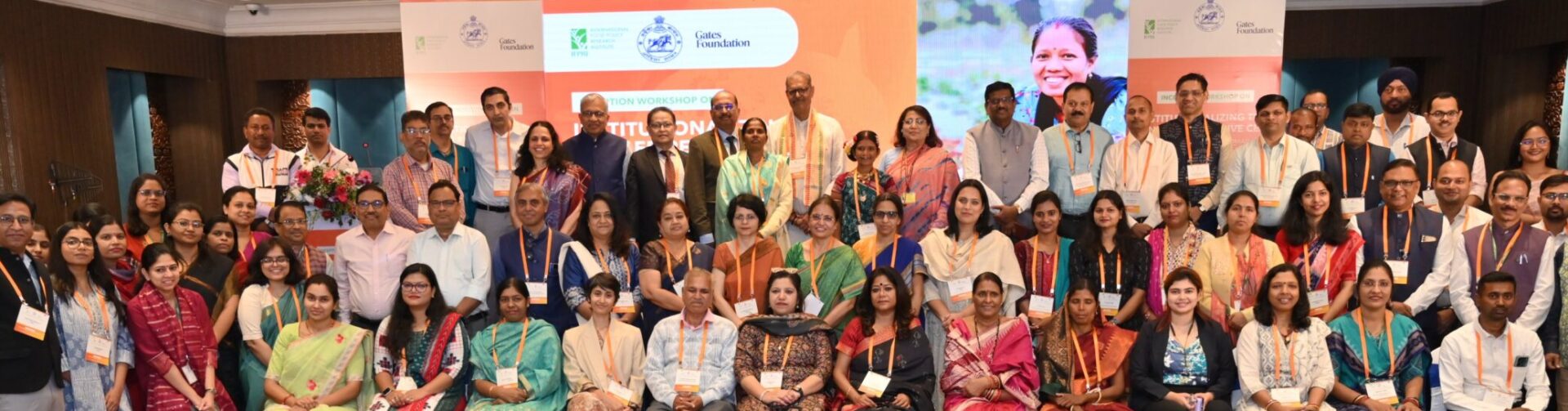
INCEPTION WORKSHOP ADVANCES OPERATIONALIZATION OF ODISHA’S GENDER RESPONSIVE CELL
On 13 February 2026, the Department of Agriculture & Farmers’ Empowerment (DA&FE), Government of Odisha, in collaboration with the International Food Policy Research Institute (IFPRI) and with support from the Gates Foundation, convened the Inception Workshop on Institutionalizing the Gender Responsive Cell (GRC): Framework and Roadmap in Bhubaneswar.
The workshop marked a significant step in operationalizing the Gender Responsive Cell, which was inaugurated in November 2025 as a dedicated institutional mechanism to embed gender responsiveness within agricultural planning, budgeting, implementation, and monitoring. Building on that milestone, the inception workshop brought together senior policymakers, researchers, development partners, and representatives of women’s collectives to align on the Cell’s institutional design and first-year roadmap.
With women accounting for a growing share of Odisha’s agricultural workforce, discussions centered on the need to move from policy intent to systematic implementation. Participants emphasized strengthening gender-disaggregated data systems, developing measurable indicators, and ensuring accountability within agricultural governance. The importance of inter-departmental convergence, particularly between agriculture, women and child development, and statistical systems, was highlighted as critical to translating women-led development into measurable outcomes.
Technical sessions examined frameworks for gender-responsive agricultural transformation, structural shifts in agriculture, climate resilience, and lessons from IFPRI-led initiatives such as the Gender, Climate Change and Nutrition Integration Initiative (GCAN). Field-level experiences from women leaders in Self Help Groups (SHGs) and Farmer Producer Organizations (FPOs) underscored the need to reduce drudgery through women-centric mechanization, strengthen access to markets and technologies, and enhance women’s leadership across value chains.
The concluding segment outlined immediate next steps for institutionalizing the GRC, including finalizing reporting structures, identifying priority gender indicators, establishing technical advisory mechanisms, and defining implementation milestones for the first year.
The workshop reaffirmed Odisha’s leadership in advancing gender-responsive agricultural governance and positioned the Gender Responsive Cell as a structured, evidence-led model for institutional reform.