QUALITATIVE METHODS OF DATA COLLECTION: PHOTO VOICE METHODOLOGY TO UNDERSTAND CLIMATE CHANGE IMPACT AND FOOD ENVIRONMENT
INTRODUCTION
Understanding the impacts of climate change on food systems requires approaches that go beyond measuring biophysical and economic outcomes alone. While quantitative methods are essential for capturing trends, magnitudes, and patterns, they often fall short in explaining how climate risks are experienced, interpreted, and negotiated in everyday life by farmers, households, and other food system actors. As climate change intensifies existing inequalities and creates highly localized and differentiated impacts, there is a growing need for research methods that foreground lived experiences, local knowledge, and social context.
ABSTRACT
Given this context, researchers are required to adjust their research strategies to better understand the heterogeneity of these impacts among various food system actors. Combining quantitative methods which capture measurable aspects with qualitative methods is thus necessary to gain deeper insights into farmers’ perceptions, decision-making processes, local knowledge systems and their interaction within the food environment. One such qualitative tool is Photo voice which is a participatory research tool. Participants click photographs to visually document their surroundings and lived experiences, combining it with narrative storytelling to express their perspectives, views or feelings about a topic. In this webinar, we will learn about three studies which use this approach in the context of Africa and India.
Athena Birkenberg's presentation explores the climate change adaptation strategies among smallholder farmers in Uganda using photovoice and cellphilms (short mobile-phone videos), with participatory impact diagrams (PIDs) and semi-structured interviews. The use of visual-digital tools helped in highlighting more context rich climate smart practices as compared to interviews, enhanced the richness of information, critical dialogue, individual participation and also improved feelings of empowerment among women.
Arindam Samaddar's presentation examines how low-income farming households in rural Bihar experience and interpret their food environment, household gastronomy and make food choices using photovoice. This visual and narrative approach revealed the role of availability and affordability in food choice, and social and cultural meanings as strong drivers of household decisions related to food. The method helped uncover everyday negotiations and household norms behind food practices, and gives evidence for designing Nutri-sensitive interventions.
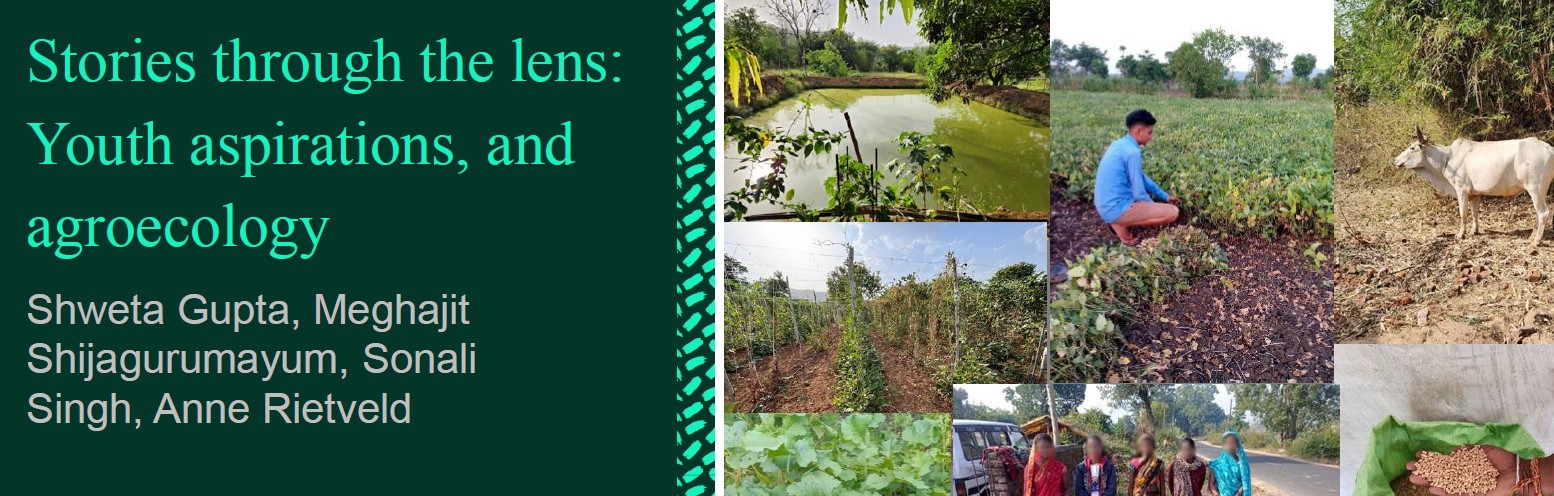
Shweta Gupta & Meghajit Sharma's presentation explores the perspectives of the youth from agriculture-dependent families towards agroecology, in Madhya Pradesh using photovoice and key informant interviews of youth and institutional stakeholders. The study helps uncover key challenges faced by youth in the region such as water scarcity, their collective awareness and knowledge about climate change, and gender differences in their experiences in agriculture. The KIIs of institutional stakeholders reveal the need for a more youth targeted policy frameworks.
Together, these studies highlight how the combined approach allows researchers to understand not just the extent of climate impacts but also the social, cultural, and institutional factors that shape how farmers experience and respond to them.
PRESENTERS
Athena Birkenberg is a postdoctoral researcher at the Chair of Social and Institutional Change in Agricultural Development, Institute of Agricultural Sciences in the Tropics (Hans-Ruthenberg-Institute), University of Hohenheim, Germany. She holds a PhD in agricultural economics and brings over 15 years of experience in empirical research, with deep expertise in participatory and qualitative methods to evaluate global agriculture value chains.
Arindam Samaddar is a Senior Manager for Qualitative Studies, Monitoring, and Evaluation at the International Rice Research Institute in New Delhi. He is an agricultural anthropologist by training, and Monitoring, Learning, and Evaluation (MLE) specialist with over two decades of experience leading interdisciplinary agricultural research and development programs across crop-livestock systems in South Asia.
Shweta Gupta is a Senior Research Analyst in International Food Policy Research Institute at the Natural Resources and Resilience Unit in New Delhi. She is a quantitative researcher, doing her PhD in Agriculture Economics from Centre for Development Research (ZEF), University Of Bonn, Germany with a research focus on agroecology and farmers aspirations in the context of India.
Meghajit Sharma Shijagurumayum is a postdoctoral researcher in Gender, Youth, and Social Inclusion at the Alliance of Bioversity International and CIAT (CGIAR), India. He has a PhD in Agriculture Extension and Communication with extensive experience in participatory and qualitative research on gender and agrobiodiversity supporting social inclusion in national agriculture extension systems.