BUILDING RESILIENT MARKETS AND LIVELIHOODS AMID CLIMATE CHALLENGES IN BIHAR
As climate change, market volatility, and structural shifts reshape India’s agri-food systems, states like Bihar find themselves at a critical crossroads. With nearly three-fourths of its population dependent on agriculture and allied activities for livelihoods, Bihar’s development trajectory hinges on how effectively it can transform agriculture beyond production, towards resilient markets, diversified livelihoods, and value-added enterprises.
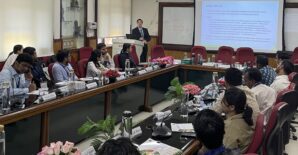
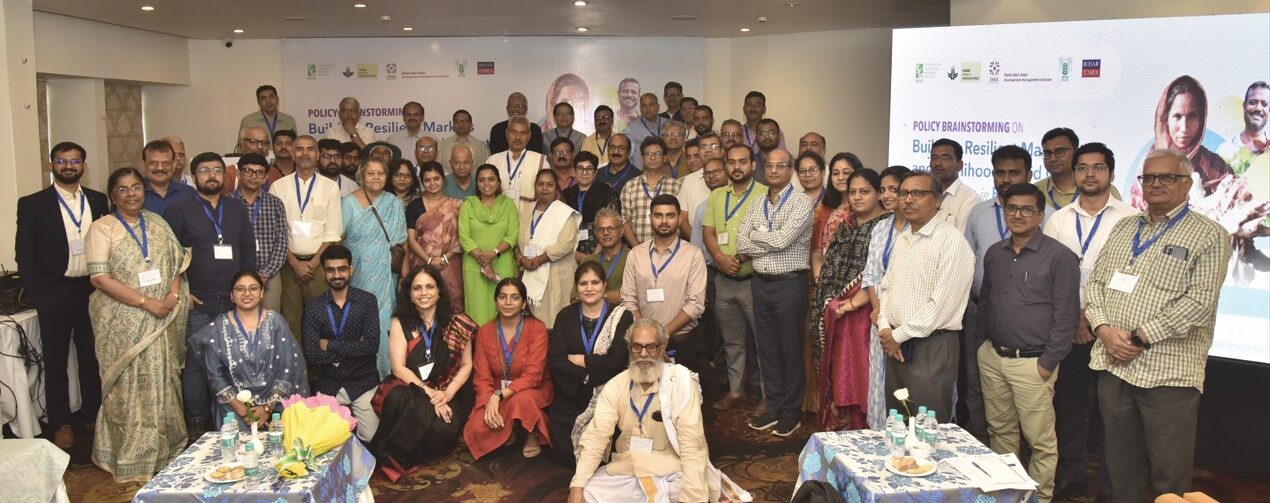
It was against this backdrop that IFPRI, in collaboration with CGIAR Science Program on Policy Innovations, Development Management Institute (DMI), ICAR-Research Complex for Eastern Region, and BiharTimes Development Foundation,, convened a high-level policy dialogue in Patna in June 2025 on Building Resilient Markets and Livelihoods amid Climate Challenges in Bihar. The day-long brainstorming brought together senior policymakers, researchers, practitioners, farmer representatives, and development partners to examine how policy innovation can help Bihar navigate the next phase of agrarian and rural transformation.
Setting the Context: Why Bihar, Why Now
Opening the dialogue, senior IFPRI leadership situated the discussion within the longer arc of agricultural development. The Green Revolution addressed the challenge of food scarcity. Today’s challenge is fundamentally different. Climate uncertainty, fragmented markets, informal employment, and nutrition transitions require new models of thinking that integrate agriculture, markets, climate resilience, and livelihoods, rather than treating them in silos.
Bihar was highlighted as a priority geography not only because of its high dependence on agriculture, but also because it represents both vulnerability and opportunity. Rapid improvements in seed replacement rates and production coexist with low levels of value addition, weak post-harvest systems, and limited integration with national and global markets. The dialogue was framed not as a lecture, but as a collective effort to identify actionable pathways.
Senior state officials, including those responsible for agriculture and food systems, underscored that agriculture must be viewed as a continuum from production to post-harvest processing to consumption. They noted that Bihar’s policy roadmaps have delivered gains in staples through assured procurement, but that fruits, vegetables, and other high-value crops remain exposed to price volatility, post-harvest losses, and weak market access. These challenges were starkly illustrated during the COVID period.
Markets, Value Chains, and Policy Innovation
A recurring theme across sessions was that agriculture value chains are now central to income growth and resilience. Speakers emphasized that policy debates often focus on integrating farmers into markets, when the more critical question is where farmers are positioned within those value chains and how much value they are able to capture.
Panel discussions highlighted that Bihar’s growth potential depends on stronger demand-side linkages, connecting farmers to urban, national, and global markets through logistics, storage, grading, and processing infrastructure. Agro-industries were repeatedly identified as stable demand anchors, with strong complementarities between food processing enterprises and farmer producer organisations.
However, ground-level realities presented a sobering contrast. Farmer representatives pointed to low awareness, mistrust, and weak governance within many farmer producer organisations and Primary Agricultural Credit Societies, a majority of which remain defunct despite substantial public investment. Several speakers stressed that education and sensitisation must precede institutional formation, arguing that policies often fail because they are designed without adequate understanding at the grassroots.
Finance, Credit, and De-risking Agriculture
Access to institutional credit emerged as a major bottleneck. Despite high agricultural dependence, Bihar receives disproportionately low levels of formal agricultural credit, partly due to high non-performing assets and risk aversion among banks. Speakers argued that credit constraints cannot be addressed through financial instruments alone. Meaningful de-risking requires changes in borrower behaviour, banking practices, supply-chain coordination, and policy incentives.
There was strong consensus that agriculture finance must move beyond template-based lending to integrated, value-chain-oriented models that bring together banks, extension agencies, farmer producer organisations, and local administration. Without such convergence, pilots and demonstrations risk remaining isolated successes rather than scalable solutions.
Climate Resilience and Systems Thinking
Climate impacts featured prominently across discussions. Participants cautioned against repeating the mistakes of mono-cropping and resource overexploitation seen in other states. Instead, they called for agro-ecological zoning within Bihar, improved water accounting, and community-led resource management.
Several speakers highlighted that Bihar already has important building blocks, including state climate action plans, renewable energy expansion, and irrigation initiatives. Implementation, however, remains fragmented. Climate-resilient agriculture, participants argued, is less about introducing entirely new practices and more about scaling proven approaches through better advisory systems, mechanisation suited to smallholders, and investments in circular economy models that reduce waste and enhance resource efficiency.
Learning from the Ground: Minor Crops, Major Lessons
One of the most striking discussions focused on so-called minor crops such as turmeric. Despite possessing high-curcumin varieties and favourable agro-climatic conditions, Bihar has struggled to translate this into competitive value chains. Speakers highlighted gaps in farmer awareness, branding, traceability, logistics, and policy recognition, contrasting Bihar’s experience with successful examples from other states.
The discussion underscored that value creation lies not only in crops, but also in by-products, processing, and branding. Policy inconsistencies, such as export bans that inadvertently affect GI-tagged products, were flagged as particularly damaging to trust and long-term investment in value chains.
Key Policy Directions Emerging from the Dialogue
Across panels, several policy insights stood out. There is a need to shift from supply-led to demand-led strategies, with value chains and agro-industries anchoring farmer incomes. Farmer producer organisations must be strengthened as learning and market institutions, not merely as procurement agents. Cluster-based, crop-specific approaches aligned with agro-ecological conditions and market demand are essential.
Climate resilience must be integrated into market and livelihood policies, rather than treated as a standalone agenda. Subsidies and incentives need to be reoriented toward sustainability, diversification, and value addition. Stronger coordination across institutions, particularly in credit, extension, and infrastructure planning, is critical.
Looking Ahead
The Patna dialogue reinforced that Bihar’s agricultural future cannot be secured through incremental adjustments alone. What is required is a coordinated policy push that aligns markets, climate resilience, livelihoods, and institutions around the realities of smallholder agriculture. As several speakers noted, agriculture may no longer employ everyone, but for those who remain, it must become more valuable, resilient, and dignified.
By grounding policy conversations in lived realities and linking them to broader structural shifts, the dialogue offered a timely platform for rethinking how Bihar, and similar states, can chart a more inclusive and sustainable agrarian transition.