SOWING CHANGE: WHAT MECHANIZED DIRECT SEEDED RICE (DSR) REVEALS ABOUT EQUITY IN CLIMATE-SMART TRANSITIONS?
Mechanized direct seeded rice (DSR) is increasingly promoted as a climate-smart alternative to puddled transplanted rice (PTR), offering water savings, reduced input costs, lower emissions, and reduced drudgery. Yet for the thousands of women in rural India who transplant rice for a living, this shift is set to reshape not only how rice is grown but also who earns from it. As machines begin to replace manual transplanting, the distribution of benefits and losses across caste, class, and gender lines, becomes a critical but underexamined question. In socially stratified agrarian settings like India, understanding who gains and who loses from a new technology is essential for ensuring that the transition to mechanization is both climate-smart and socially ‘just.’
Why DSR matters now: The promise and the trade-offs
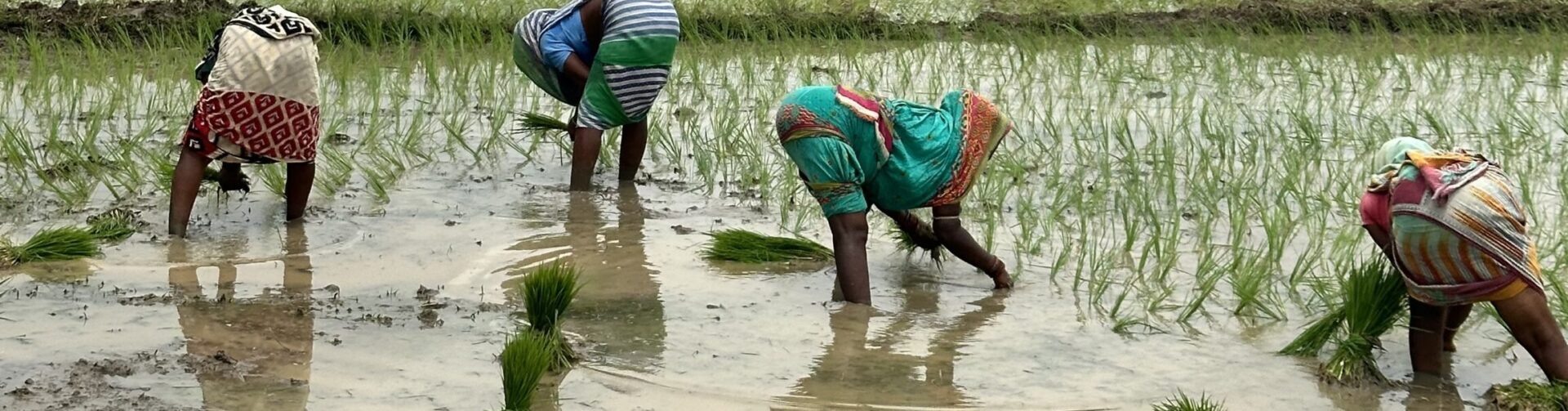
Conventionally, PTR involves growing seedlings in a nursery and then transplanting them into flooded or repeatedly puddled fields, a task overwhelmingly carried out by women farmers including female agricultural laborers in India. However, this method of growing rice has drawn criticism for being resource-intensive (water and labor) considering depleting resources, and PTR is also associated with soil compaction and high methane emissions. Transplanting is also drudgery-prone and intensifies women’s labor burden, even as it provides a source of income.
DSR involves establishing rice by directly sowing seeds into the fields, reducing the environmental impact of PTR while also reducing production costs. For mechanized DSR, ungerminated rice seeds are drilled by machines on unpuddled soil. Sequencing mechanized DSR with reduced or zero tillage wheat is being recognized as an important technological innovation for enhancing sustainability in rice-wheat systems.
Policymakers and scientists point to other benefits too: DSR helps avoid soil degradation from repeated puddling and makes harvesting easier by aligning the crop cycle better with dry periods. It also renders rice fields more conducive to mechanization of other farm operations (weeding, targeted herbicide application, harvesting) by sowing seeds in well-defined, precise rows and creating a drier, firmer seedbed. Evidence also suggests that DSR crops are less prone to water lodging under adverse weather conditions like heavy rain or strong winds.
Thus, DSR is gaining importance in recent times as a promising sustainable approach to rice production, globally and in India.
This study is being conducted in Odisha, one of the major rice-growing states in India. We use qualitative case study research methods to explore the mechanisms driving gendered and labor aspects of mechanized DSR adoption.
Who gains and who loses?
Extensive field trials confirm that there are significant gains that can be realized from mechanized DSR, such as reduced cultivation costs, improved soil moisture, and lower drudgery. For farmers, especially in a state like Odisha where agricultural wages are rising and rainfall is unpredictable, DSR offers a timely and efficient solution.
In Odisha, like in much of India, rice is one of the most important crops, and the shift to DSR involves fundamental changes in production processes, which is likely to have impacts on local labor markets and wages.
The agriculture sector in Odisha employs more than 70 percent of the rural women workforce, who are mostly engaged in rice farming. Historically, paddy cultivation relied on family labor; however, over the years, this shifted and now casual hired labor (those who work on others’ farms for wages) accounts for approximately 50%[1] of the total labor used in rice cultivation in Odisha.
To understand the implications of mechanized DSR through an intersectional lens focusing on gender, class and ethnicity, our study considers the following four kinds of rural households:
- Large landowners who hire labor and own machinery;
- Family farmers who rely on own family labor;
- Landless laborers who depend on wage work; and
- Non-farming landowners who lease their land
Large landowners, often belonging to socially privileged caste groups, are likely to benefit the most from the adoption of mechanized DSR. They usually hire laborers to carry out agricultural activities, and mechanized DSR would lead to significant reductions in their cost of cultivation and enhance their profitability. They are likely to own agricultural machinery, especially tractors, and have the means to make the initial financial investment required to utilize the DSR machine subsidy. They also have access to information and irrigation facilities, critical for the success of DSR. Reduced drudgery from mechanized DSR is not of particular importance to them. Even though such households constitute only a small share of the farmers in Odisha, they control about one-fourth of the state’s land area[2]. Therefore, their decisions have a larger impact on the local economy. Further, non-farming landowning households, who otherwise do not influence mechanization decisions, may lease out their land to such households to earn higher returns from agriculture. This development could accelerate mechanized DSR adoption.
The second category of households, family farmers form the largest share of the farming community in Odisha. They are categorized as marginal and small farmers based on their landholding size. Reduced drudgery from DSR adoption directly impacts the female members of these households. However, since transplanting is carried out by family members, they do not save much in labor costs, hence they do not have strong financial incentives to adopt DSR. In fact, hiring machines would involve additional costs for the household as they usually do not own tractors and are unable to extensively leverage machine subsidies. Many such farmers belong to less privileged caste groups and may face constraints in terms of access to resources. If these households find alternative income opportunities for their family labor, it would be economically viable for them to adopt DSR, contingent on the size of their landholding, and the feasibility of operating the seed-drill machines in these farms.
The category that is clearly negatively affected by DSR adoption at scale are landless laborers, especially women agricultural workers who are engaged in transplanting. They usually belong to historically marginalized groups (SC/ST) and typically do not have the resources to acquire alternative skills needed to find scarce non-farm jobs. They often do not have the financial and social capital to lease more land or own machinery, so wage labor is the primary source of livelihood for these households. Women primarily transplant rice, often for 30–40 days during Kharif season. They shared that they are usually paid around INR 240 per day on an average as wages.
Transplanting in a one-acre paddy field takes about 120 hours and nursery preparation for this takes around 4 hours. Assuming that each workday is eight hours long on an average, the average hourly wage for women agricultural laborers is INR 30. DSR replaces this activity with machines leading to around 124-hour reduction in women’s labor per acre. This reduces labor demand by over 40% for women resulting in a wage loss of INR 3720 per acre on an average, while also reducing women’s already limited workdays in the agricultural calendar.
Ripple effects, roadblocks, and unintended consequences
Mechanization may improve productivity, but without support systems in place, it risks deepening existing inequalities.
Women laborers already face barriers to entering non-farm jobs due to mobility constraints, safety concerns, and social norms. While we may hope that displaced workers can shift to other forms of labor, in reality there are limited alternatives, especially in rural areas.
Odisha’s public employment schemes like Mahatma Gandhi National Rural Employment Guarantee Scheme (MGNREGS) are underperforming. Only 0.2% of rural casual employment comes from public works programs. However, women’s self-help groups (SHGs) formed under the Government of Odisha’s Mission Shakti department offer potential pathways to support women’s enterprises, but these need to be better connected with agricultural transitions like DSR.
Finally, the losses are not just economic - reduction in women’s income will affect household incomes, which in turn will also have adverse effects on children’s education and household nutrition. Losing work also means losing a source of independence, status, and bargaining power for the majority of women agricultural workers.
Building a ‘just’ transition to mechanized DSR
While PTR and beushening continue to be the most prominent methods of establishing paddy in Odisha, the insights from this study show that, as we progress towards climate-smart agricultural transitions, we should not only care about efficiency and productivity but also rethink who benefits and who bears the burden. Mechanized DSR can support climate-resilient farming, but it will only contribute to sustainable development if the hands it frees are not forgotten.
To ensure that DSR leads to inclusive growth, policymakers need to design strategies that are sensitive to gender and to the social stratification of rural households. These include the following:
- Reconsidering subsidy programs for machinery that primarily benefit large farms and displace hired labor;
- Creating alternative farm and non-farm income opportunities for displaced women laborers;
- Strengthening MGNREGS and linking SHGs with agro-services, including access to mechanization; and
- Offering targeted training and support to women farmers and service providers to increase women’s knowledge and skills in machinery and equipment use, and maintenance.
This study was supported by the Gates Foundation funded project Cereal Systems Initiative for South Asia (CSISA); and the writing and editing was also supported by the CGIAR Climate Action Science Program. The authors would like to thank all funders who supported this research through their contributions to the CGIAR Trust Fund: https://www.cgiar.org /funders/.
Prapti Barooah is a Senior Research Analyst in the Natural Resource and Resilience (NRR) Unit at International Food Policy Research Institute (IFPRI) in New Delhi and is a PhD candidate at University of Hohenheim, Germany. Regina Birner is Chair of Social and Institutional Change in Agricultural Development at the University of Hohenheim, Germany. Christine Bosch is a postdoctoral researcher at University of Hohenheim, Germany. Muzna Alvi is a Research Fellow in the NRR Unit at IFPRI. Sugandha Munshi is a Senior Associate Scientist- Gender Empowerment at International Rice Research Institute (IRRI). Ashok Kumar is a Senior Associate Scientist at IRRI and the Coordinator for IRRI-DSR-Odisha project. Virender Kumar is a Research Director - Sustainable Impact through Rice-based Systems at IRRI.
This post is based on research that is not yet peer reviewed. Opinions are those of the authors.
Header picture credits: Prapti Barooah
[1] Authors’ calculation based on 2016-17 Commission for Agricultural Costs and Prices (CACP) data
[2] Authors’ calculation based on 2016-17 Commission for Agricultural Costs and Prices (CACP) data