IFPRI–AERA POLICY DIALOGUE ON TRANSFORMING AGRI-VALUE CHAINS
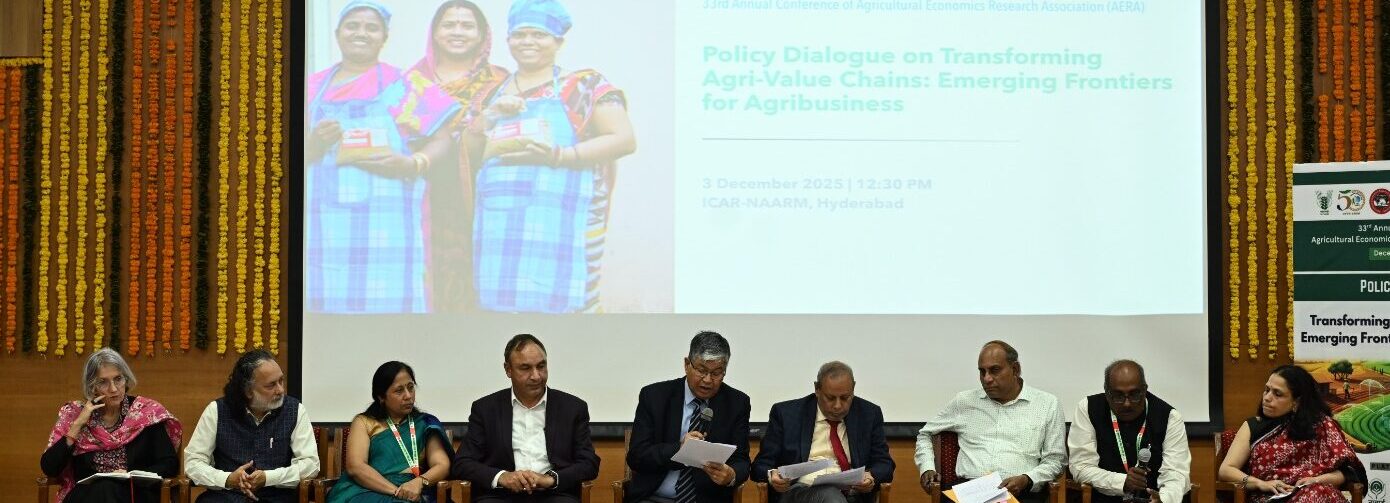
The IFPRI-AERA session on “Transforming Agri-Value Chains: Emerging Frontiers for Agribusiness” held on 3 December at the Indian Council of Agricultural Research (ICAR)-National Academy of Agricultural Research Management (NAARM) in Hyderabad. The event brought together an diverse lineup of policymakers, researchers, and development practitioners to examine how India can steer its agri-food system transformation in an inclusive, equitable, and sustainable direction. A major highlight of the session was the participation of Prof. Mahendra Dev, Chairman of the Prime Minister’s Economic Advisory Council, whose presence added both depth and strategic relevance to the deliberations. The panel was co-chaired by Prof. Dev and Dr. P.K. Joshi, President of Agricultural Economics Research Association, India (AERA) with Dr. G. Narendra Kumar, Director General, National Institute of Rural Development and Panchayati Raj (NIRDPR) as the Guest of Honor and featured speakers representing the financial sector, international research, agri-startup incubation, global development, and mountain agriculture - reflecting the multidimensional nature of value-chain transformation in the country.
In setting the context, the session underscored that Indian agriculture is in the midst of a structural shift: the sector’s share of GDP is declining even as its importance in livelihoods and food security remains high. Much of this transition is occurring through Agriculture Value Chains (AVCs), where agribusiness - ranging from inputs and logistics to processing and retail - plays a pivotal role. Speakers discussed how demographic changes, especially the feminization of agriculture, the rising role of agri-enterprises in women’s employment, and the growing interconnectedness of global markets are reshaping opportunities and challenges for farmers and rural economies.
The panel contributed a set of grounded policy insights. On agricultural finance, it was noted that more flexible credit instruments, blended finance, and better risk-management tools are essential to support smallholders and FPOs participating in value chains. On global partnerships, the discussion highlighted the importance of leveraging international research linkages and comparative experiences to accelerate technology adoption, particularly in areas of climate resilience, mechanization, and quality standards. On startups, the session underscored the need to strengthen incubation systems, reduce regulatory bottlenecks, and foster partnerships between government, incubators, financial institutions, and industry to enable innovation-led value-chain solutions.
Speakers also emphasized that social protection and value-chain development must work hand in hand. With rapid market and technological change, rural households - particularly women and vulnerable groups - need safety nets that support adaptation, skill development, and resilience. From the perspective of agro-ecologically fragile regions, such as the Himalayas, the panel stressed the urgency of context-specific policies that improve market access, incentivize sustainable production, and integrate mountain agriculture more effectively into national value chains.
Across these diverse perspectives, several common messages emerged. First, farmers - especially women - must be better integrated into value chains through stronger producer organizations, targeted skills, and more responsive extension systems. Second, quality, safety, and standards require urgent regulatory strengthening to ensure India competes effectively in global markets. Third, institutional readiness, from Panchayati Raj Institutions to rural enterprises, is central to navigating faster technological change, emerging commodities, and complex food environments. Finally, the dialogue emphasized that markets must be guided, not left alone - so that agribusiness growth reinforces national goals on nutrition, health, and environmental sustainability.
Overall, the session highlighted a clear direction: India must pursue policy innovations that combine market dynamism with strong institutions and inclusive governance. These insights offer a practical foundation for shaping agricultural and rural policy at the national and state levels, ensuring that value-chain transformation benefits farmers, strengthens food systems, and drives equitable economic growth.
Learn more from the detailed session proceedings here.